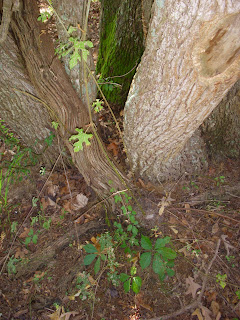

How do these vines develop to such size and crawl up these trees? This is a dramatic illustration. This tree sits in the middle of a field. It is engulfed by a mature vine. At the base of the tree the main vine trunk nearly looks like another portion of the main tree.
In all of our walks, it is hard to find 'young' vines. However, this vine had small, new shoots which emerge from the base of the main vine trunk. Close ups of the small slender shoot find tendrils - and the 'climb' begins.
Tendrils are often spring-like and cinch up a plant to the support by decreasing the overall length of the tendril. This coiling feature utilizes high friction for grasping structures. For vines, tendrils are a cheap way to climb, but a tendrilar system does not hold great weight. This mechanism is good for clinging during strong winds, and absorbs and dissipates energy. Development of tendrils is sylleptic and determinate.
Examples:
- long young tendrils are extended to find a support in a bignon
- in Marah macrocarpus can be seen here that a coiled tendril may be stretched
- in Tetrastigma voinierianum, young tendrils extended in search of support
Twining often occurs in one direction, and many show a predisposition to turn to the right. There is a limit to the size trunk that most twiners can use, and hardly ever are twiners found around thick trunks.


